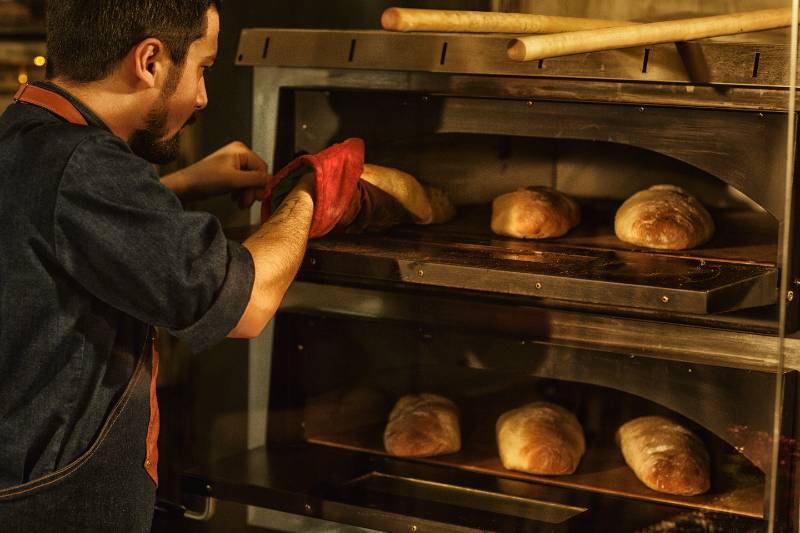
If you are trying to decide between a deck oven, a convection oven, and a tunnel oven, the choice comes down to three things: how much you bake in a day, what products you bake, and how much floor space and budget you have. Deck ovens suit artisan bread and pizza with hearth-style crust. Convection ovens suit cookies, cakes, and multi-rack batch baking. Tunnel ovens suit high-volume, continuous production where consistency at scale matters more than hands-on control. This guide breaks down how each oven works, where it fits best, and how to match one to your bakery’s real production needs.
Key Takeaways
• Deck ovens use radiant heat from stone or steel decks and are the standard choice for artisan bread, bagels, and pizza that need a strong, even crust.
• Convection ovens use fan-forced hot air for even, consistent baking across multiple racks, making them a good fit for cookies, cakes, pastries, and mixed-product bakeries.
• Tunnel ovens move product through the oven on a conveyor belt and are built for continuous, high-volume production runs.
• Deck and convection ovens generally cost less upfront and fit smaller footprints. Tunnel ovens require the largest investment and space, but lower the labor cost per unit at scale.
• The right choice depends on your product mix, daily volume, and available space and utilities, not on which oven is technically the most advanced.
What Is a Deck Oven and When Should You Use One?
A deck oven bakes directly on a flat stone or steel deck, using radiant heat from below (and often above) rather than moving air. This produces the strong, even crust that artisan bakeries and pizzerias rely on.
Best Uses for Deck Ovens
• Artisan and hearth breads that need a crisp crust
• Bagels and rolls that benefit from direct heat contact
• Neapolitan and New York style pizza
• Bakeries that value hands-on control over each bake
Deck Oven Pros and Cons
• Pro: Produces a superior crust and bake floor for bread and pizza
• Pro: Lower upfront cost compared with tunnel ovens
• Con: Lower throughput than convection or tunnel ovens
• Con: Requires more manual loading and unloading per batch
What Is a Convection Oven and When Should You Use One?
A convection oven uses internal fans to circulate hot air around the product, which bakes multiple racks evenly at once. This makes it a versatile workhorse for bakeries producing a mix of items rather than a single specialty product.
Best Uses for Convection Ovens
• Cookies, muffins, and cakes baked across multiple sheet pans
• Pastries and laminated dough that need even color
• Bakeries with a varied product menu
• Operations that need faster recovery time between batches
Convection Oven Pros and Cons
• Pro: Even heat distribution across every rack
• Pro: Compact footprint, and many models stack to save floor space
• Con: Airflow can dry out crusty artisan breads compared with a deck oven
• Con: Still batch based, so throughput is capped by rack capacity
What Is a Tunnel Oven and When Should You Use One?
A tunnel oven carries product on a continuous conveyor belt through multiple heated zones, allowing a bakery to bake large volumes without stopping to load and unload individual batches. This is the equipment tier built for wholesale, contract, and high-volume retail production.
Best Uses for Tunnel Ovens
• Wholesale and contract bakeries running long production shifts
• Standardized products such as buns, sliced bread, and crackers
• Operations that need consistent output hour after hour
• Facilities planning for growth beyond batch-oven capacity
Tunnel Oven Pros and Cons
• Pro: Highest sustained throughput of the three oven types
• Pro: Lower labor cost per unit once the line is running
• Con: Highest upfront investment and installation cost
• Con: Requires a larger dedicated footprint and utility capacity
Which Oven Type Produces the Best Bake Quality?
There is no single answer. Deck ovens generally produce the best crust and bake floor for bread and pizza. Convection ovens produce the most even color and texture across mixed products like cookies and cakes. Tunnel ovens produce the most consistent results batch after batch at high volume, though fine-tuning a tunnel oven’s zones takes more setup time than a single deck or convection unit.
How Much Space, Power, and Ventilation Does Each Oven Require?
Space and utility requirements scale with output capacity.
• Deck ovens: Compact to mid-sized footprint, often stackable in multiple decks to add capacity without adding floor space.
• Convection ovens: Smallest footprint of the three, and many are countertop or roll-in models. Proper ventilation hoods are still required to manage heat and moisture.
• Tunnel ovens: The largest footprint by far, frequently needing a dedicated room with reinforced flooring, higher electrical or gas capacity, and integration with conveyor systems for infeed and outfeed.
Whichever oven you choose, confirm gas line capacity, electrical service, and exhaust ventilation before finalizing a purchase. Retrofitting utilities after installation is far more expensive than planning for them up front.
What Does Each Oven Type Cost to Buy and Operate?
Deck and convection ovens carry a lower upfront cost and are more accessible for new or growing bakeries. Tunnel ovens require the largest capital investment, both for the oven itself and for the supporting infrastructure, but they reduce labor cost per unit once production volume justifies the investment.
• Buying pre-owned equipment is a practical way to control costs. Browse recently listed pre-owned ovens to see current inventory across all three oven types.
• If cash flow is a factor, financing options can spread the cost of a larger oven purchase, including tunnel ovens, over time.
How Do You Choose the Right Oven for Your Bakery?
Work through these questions in order:
• What products make up most of your daily production: bread and pizza, mixed pastries, or standardized high-volume items?
• How many units do you need to produce per day, and how is that likely to change in the next two to three years?
• How much floor space, utility capacity, and budget do you have available right now?
• Do you need flexibility to bake multiple product types, or are you optimizing one product line at scale?
A bakery baking artisan loaves and pizza will usually get the best result from a deck oven. A bakery with a varied retail case of cookies, cakes, and pastries will usually get more value from a convection oven. A wholesale or contract bakery running long shifts of standardized product is the clearest case for a tunnel oven.
Common Mistakes and Misconceptions
• Assuming a tunnel oven is always the better investment. It only pays off once daily volume justifies the footprint and cost.
• Overlooking ventilation and utility upgrades until after the oven arrives, which delays installation and adds cost.
• Buying oven capacity based on peak season demand rather than average daily production.
• Choosing a single oven type to handle every product, when a mixed bakery menu often performs better with a combination, such as a deck oven for bread alongside a convection oven for pastries.
Expert Tips and Best Practices
• Map your product mix first, then size the oven to that mix rather than choosing equipment and adjusting the menu around it.
• Pair oven selection with proofing and retarding equipment sized to match your bake schedule, since mismatched proofing capacity is a common bottleneck.
• Get utility requirements confirmed by an installer before purchase, especially for tunnel ovens that need dedicated gas, electrical, or steam capacity.
• Review the full oven category to compare brands and models side by side once you know which oven type fits your operation.
Conclusion
Deck, convection, and tunnel ovens each solve a different production problem. Deck ovens deliver the crust and bake floor artisan bread and pizza need. Convection ovens deliver even results across a varied product menu. Tunnel ovens deliver consistent output at high volume for wholesale and contract production. The right choice comes down to matching the oven to your product mix, daily volume, and available space, not choosing the most advanced option available.
Ready to compare options? Browse our full Ovens category for new and pre-owned deck, convection, and tunnel ovens, or contact our team for help matching an oven to your production volume and budget. Have equipment to move as you upgrade? Sell your used equipment through our listings.
What is the main difference between a deck oven and a convection oven?
A deck oven bakes with radiant heat from a stone or steel surface, producing a strong crust for bread and pizza. A convection oven bakes with fan-circulated hot air, producing even results across multiple racks for mixed products like cookies and cakes.
Can a small or new bakery use a tunnel oven?
Tunnel ovens are built for continuous, high-volume production and usually require more floor space and utility capacity than a small or new bakery has available. Most small bakeries start with a deck or convection oven and move to a tunnel oven once volume grows enough to justify it.
Which oven type is best for artisan bread?
A deck oven is the standard choice for artisan bread because the direct heat from the deck surface produces a stronger, more even crust than fan-forced or conveyor baking.
Do convection ovens work for pizza?
Convection ovens can bake pizza, but a deck oven typically produces a better crust and bake floor for hearth-style and Neapolitan pizza. Many pizzerias use deck ovens for that reason.
How do I know when it is time to upgrade from a deck or convection oven to a tunnel oven?
Consider a tunnel oven once your production volume regularly exceeds what your current batch ovens can handle in a normal shift, or once labor cost per unit becomes a limiting factor in your growth.