Opening or upgrading a bagel or donut shop comes down to a short list of equipment decisions: a commercial donut fryer or a bagel boiling kettle, a mixer built for dense or high-hydration dough, a proofer, and a display case, plus an oven if bagels are on the menu. Startup equipment costs can vary widely, from a small shop built mostly on pre-owned equipment to a fully new, high-volume build. The equipment mix that makes sense depends on daily production volume, product line, and available gas or electrical service, all covered in detail below.
Key Takeaways
- Donut shops need a fryer, proofer, mixer, cutter or dropper, glazer, and display case.
- Bagel shops need a mixer, divider, boiling kettle, deck or rack oven, and a retarder-proofer.
- Gas fryers and kettles cost less to run at high volume; electric units skip the gas line requirement.
- Pre-owned equipment can meaningfully cut startup costs when properly inspected.
- Kettle and fryer sizing should match daily volume, not a future best-case scenario.
- Financing and equipment resale programs help manage cash flow during a buildout.
What Equipment Do You Need to Open a Bagel or Donut Shop?
Direct answer: the two product lines share mixing, proofing, and finishing equipment, but diverge on the core cooking step: frying for donuts, boiling and baking for bagels.
Donut Shop Equipment List
A donut shop needs a commercial donut fryer, whether floor or countertop, gas or electric, along with a donut proofer for controlled rise before frying and a donut cutter or depositor/dropper for cake and yeast donuts. Finishing runs through a donut tumbler for sugar, cinnamon, or glaze coating, plus a glazer and finishing table, backed by screens, draining racks, and oil filtration. Round out the line with a mixer sized to daily batter or dough volume and a display case for the finished product.
Bagel Shop Equipment List
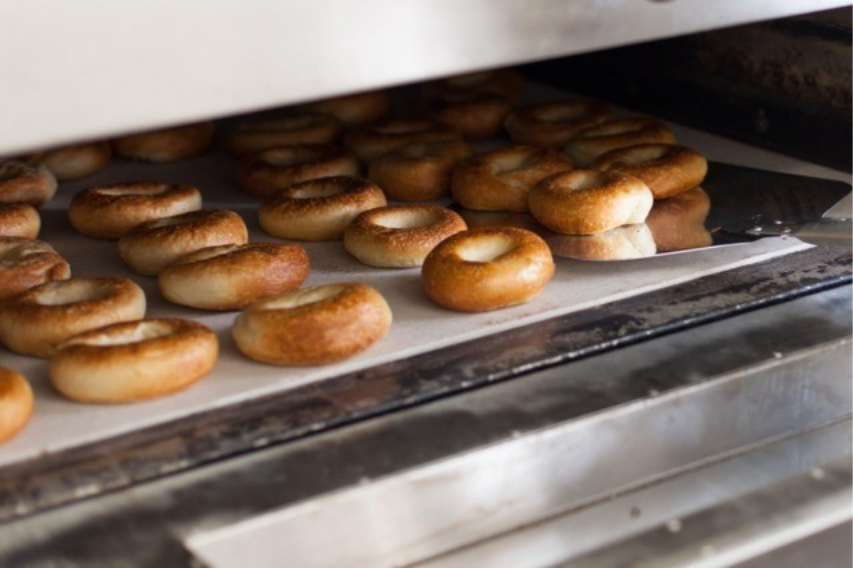
A bagel shop needs a spiral mixer built for low-hydration, dense bagel dough, along with a divider and rounder for consistent bagel weight. The core cooking sequence runs through a bagel boiling kettle, gas or electric, followed by a deck oven or rack oven for baking after boiling. A retarder-proofer handles overnight cold fermentation, while work tables, dough bins, and transit racks support daily production, and a display case or bagel merchandiser finishes the line.
Donut and bagel shops share the same broad workflow but diverge across several equipment categories. On mixing, donut shops typically use a planetary or spiral mixer for batter or dough, while bagel shops need a spiral mixer built specifically for dense, low-hydration dough. The core cooking step marks the biggest split: donut shops rely on a fryer, gas or electric, while bagel shops boil shaped dough in a kettle before baking it in a deck or rack oven. Shaping tools differ too, with donut dough shaped by a cutter, depositor, or dropper, and bagel dough shaped by a divider and rounder. Proofing also varies, since donut dough rests in a donut proofer while bagel dough typically rests overnight in a retarder-proofer. On finishing, donuts pass through a tumbler or glazer, while bagel toppings are applied either pre-bake or post-bake. Both product lines end with a display case, though bagel shops often add a dedicated bagel merchandiser.
How Does a Commercial Donut Fryer Work, and Which Type Should You Choose?
Direct answer: a commercial donut fryer holds oil at roughly 350 to 375 degrees Fahrenheit and comes in gas or electric configurations, sized by oil capacity and daily dozens produced. The right choice depends on utility access, footprint, and volume.
Gas vs Electric Donut Fryers
Gas and electric donut fryers differ in a few key ways. Gas fryers recover heat faster between batches, while electric fryers recover more slowly, with speed varying by wattage. On installation, gas fryers require a gas line and ventilation, while electric fryers need adequate electrical service but no gas line. Operating cost tends to favor gas at high volume, while electric fryers can run higher depending on local utility rates. Taken together, gas fryers suit high-volume shops with existing gas service, while electric fryers suit retrofits or locations without gas access.
Countertop vs Floor Model Fryers
Countertop fryers suit lower daily volume, typically under 200 dozen per day, and fit tighter kitchens, while floor model fryers handle higher throughput for busy single locations or shops supplying wholesale accounts.
Browse current options in the donut fryer collection, including new floor model fryers and countertop fryers, to compare current inventory and pricing.
What Is a Bagel Boiling Kettle, and Why Is It Essential?
Direct answer: a bagel kettle boils shaped bagels for roughly 30 to 60 seconds per side before baking. That short boil sets the crust and creates the dense, chewy texture that separates a bagel from a bread roll.
Kettle size is measured by diameter, not gallons, since bagels float rather than fill the tank. Gas kettles recover heat faster between batches, which matters for continuous production, while electric kettles avoid the need for a gas line, useful in retrofitted spaces. Either way, look for BISSC-approved, NSF-certified construction, since not every kettle on the market meets that sanitation standard.
Gas and electric bagel kettles differ in similar ways to fryers. Gas kettles recover heat faster between batches, which matters for continuous production, while electric kettles recover more slowly and suit lower-volume production. On installation, gas kettles require a gas line and venting, while electric kettles require sufficient electrical service. Gas kettles generally cost less per batch at volume, while electric kettles have a simpler install but a higher per-unit energy cost. That trade-off means gas kettles suit high-volume bagel bakeries, while electric kettles suit small shops or spaces without gas access.
See current bagel kettle inventory and pre-owned kettles to compare gas and electric models by diameter and capacity.
New vs Used Equipment: Which Is Right for Your Startup Budget?
Direct answer: pre-owned equipment can meaningfully reduce upfront costs, while new equipment lowers the risk of downtime and typically includes manufacturer warranty coverage. Most shops use a mix of both.
New and used equipment trade off differently across several factors. Upfront cost runs higher for new equipment and lower for used. New equipment carries a full manufacturer warranty, while used equipment carries a limited or dealer-backed warranty that varies by seller. Lead time also differs: new equipment can take weeks to arrive depending on the manufacturer, while used equipment is often available for immediate shipment. Condition risk is minimal with new equipment, while used equipment requires inspection of burners or heating elements, seals, and controls.
When evaluating used equipment, check the condition of burners or heating elements, gaskets and seals, and control panels, and confirm that NSF or BISSC sanitation certification labels are still intact. Ask the seller for maintenance history and whether the unit was run-tested before sale.
What Other Equipment Completes a Bagel or Donut Shop Setup?
A complete setup also needs proofing cabinets that hold consistent temperature and humidity for even rise, plus refrigeration for cream cheese, fillings, dairy, and perishable toppings. Ventilation hoods are required by most local codes above fryers and ovens, and display cases handle both merchandising and food safety compliance. Packaging equipment for bagging, labeling, and wholesale or retail orders rounds out the setup.
For dough preparation on the bagel side, a properly sized mixer matters as much as the kettle itself. Our companion guide,
Dough Mixers, Sheeters & Dividers: A Complete Buyer’s Guide, breaks down spiral versus planetary mixer selection in more depth, and the full mixer collection shows current new and pre-owned options.
Common Mistakes and Misconceptions
- Assuming a standard deep fryer works for donuts. Donut fryers are built for different oil capacity, temperature recovery, and filtration than restaurant deep fryers.
- Underestimating ventilation and gas line requirements before purchasing equipment, which can delay a health department or fire marshal inspection.
- Buying used equipment without confirming NSF or BISSC sanitation certification is still valid.
- Undersizing kettle diameter relative to daily bagel volume, which creates a production bottleneck during peak hours.
- Skipping a written maintenance history request when buying pre-owned fryers or kettles.
Expert Tips and Best Practices
- Size equipment to current daily volume, not a future best-case projection. Equipment can be added as demand grows.
- For a bagel kettle, prioritize diameter and burner BTU output over total gallon capacity.
- Budget for installation separately from equipment cost. Gas lines, dedicated circuits, and ventilation often add meaningfully to a project’s total.
- Use equipment financing to preserve working capital for buildout, staffing, and initial inventory.
- Work with a dealer that offers service support after the sale, not just a sales transaction.
Conclusion
The core decision when equipping a bagel or donut shop is matching fryer or kettle type, size, and fuel source to actual daily volume, then filling out the rest of the line with a properly sized mixer, proofer, and display case. Weighing new against pre-owned equipment against that volume, rather than against a hoped-for future capacity, keeps both the upfront budget and the operating cost realistic.
Costs vary widely depending on scope. A small donut shop built primarily on pre-owned equipment costs considerably less than a fully new, higher-volume setup with a floor model fryer, proofer, mixer, and display case. Get a customized quote from a bakery equipment dealer for an accurate estimate based on your specific equipment list and volume needs.
Kettle sizing depends on daily bagel volume rather than store size. Since bagels float, the inside diameter of the kettle, not its gallon capacity, determines how many bagels can boil per batch. A shop producing a few hundred bagels per day can typically run a smaller-diameter kettle, while wholesale or multi-location operations need a larger diameter and faster heat recovery.
Yes, when it comes from a reputable dealer and has been inspected and run-tested. Check that burners or heating elements, seals, and controls are functional, and confirm NSF or BISSC sanitation certification is still present on the equipment.
Gas equipment generally offers faster heat recovery and lower operating cost at high volume but requires a gas line and ventilation. Electric equipment installs without a gas line, which makes it a common choice for retrofitted spaces or locations where gas service is not available.
Yes. Equipment financing and leasing options are commonly available for both new and pre-owned commercial bakery equipment, which helps preserve cash for buildout costs, staffing, and opening inventory rather than tying up capital in equipment purchases.